Starter strip shingles: Factory starter vs. cut 3-tab
Quick answer
Factory starter products offer a purpose-made edge course with factory-positioned sealant and documented coverage. A field-made starter from a cut shingle may be acceptable only when the selected shingle manufacturer's current instructions permit that exact method.
Common questions
- Do starter strip shingles go at both eaves and rakes?
- Many asphalt-shingle systems specify starter at eaves and rakes, but the exact locations, sequence, projection, and fastening must follow the selected shingle and starter instructions plus local requirements. The bid should name both edges rather than say only 'starter.'
- Can a roofer use cut 3-tab shingles as starter?
- Only when the selected roof system's current instructions allow a field-made starter and the crew follows that method. Cutting off tabs without confirming sealant position, orientation, fastening, and compatibility can leave the edge course unsupported.
- How much starter strip should a roofing bid include?
- Quantity starts with measured eave and rake lengths, then accounts for the product's current package coverage, required laps or starter pieces, corners, dormers, waste, and any enhanced edge details. Do not apply a universal bundle-coverage number.
Source note: Reviewed against current Owens Corning Duration and starter-component instructions plus GAF starter-strip product and installation guidance. Product documents, warranty terms, and local requirements control each roof.
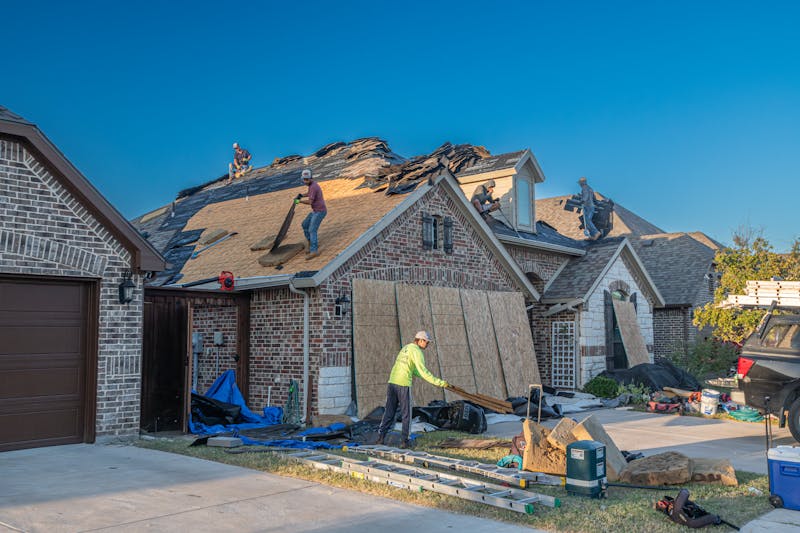
The first visible field shingle is not the first layer of an asphalt-shingle roof. Beneath it, a starter course helps establish the roof edge and provides adhesive where wind pressure can work hardest at eaves and rakes.
The important comparison is not simply “factory starter or cheaper 3-tab.” It is whether the proposed material puts sealant, fasteners, laps, and edge projection where the selected roof system requires them.
What starter strip shingles do
Starter material is installed before the first field course along specified roof edges. Depending on the product and system, it helps:
- Provide a backing layer beneath joints in the first shingle course
- Position factory-applied adhesive near the outer edge
- Help bond the first course against wind uplift
- Establish a straight starting line and intended edge projection
- Coordinate shingles with drip edge, underlayment, and leak barrier
- Satisfy component or enhanced-wind conditions named in current warranty documents
Starter is not a substitute for ice barrier, underlayment, or drip edge. GAF’s QuickStart instructions explicitly distinguish its starter roll from self-adhering waterproof underlayments used for ice-dam and rain protection. Review the current QuickStart guidance.
Eaves and rakes are different edges
The eave is the horizontal lower edge where runoff normally reaches a gutter or falls clear. The rake is the sloped gable edge running toward the ridge.
Their surrounding details differ. The eave may include gutters and leak barrier; the rake has side exposure and its own edge detail.
A bid that says only “starter included” leaves important questions unanswered:
- Is starter included at eaves, rakes, or both?
- Which product is used at each location?
- How are eave-to-rake corners and dormer edges handled?
- Does the sequence match the selected shingle instructions?
- Is enhanced edge work required by local wind provisions or the chosen system?
Review the metal and underlayment sequence in our roof drip edge repair and replacement guide. Starter must be coordinated with that assembly, not added as an isolated strip.
Factory starter vs. cut 3-tab at a glance
| Question | Factory starter product | Cut 3-tab or field-made starter |
|---|---|---|
| Intended use | Manufactured and documented as a starter component | Acceptable only when the field-shingle instructions describe the method |
| Sealant | Factory-positioned for the stated orientation and edge use | Position depends on the shingle design, cut, and orientation |
| Compatibility | Listed for specific shingle families, dimensions, or exposures | Must be confirmed in the selected shingle instructions |
| Coverage | Published by the manufacturer for the current package | Must be calculated from the permitted cut pattern and waste |
| Installation | Product-specific sequence, fastening, laps, and release-film steps | Field-cut sequence and fastening must be followed exactly |
| Warranty role | May be an eligible or required accessory under stated terms | May not satisfy system or wind-coverage terms unless expressly allowed |
| Crew handling | Purpose-made pieces or roll can reduce roof-top cutting | More layout and cutting creates more opportunity for orientation errors |
Why sealant position matters
The first field course needs adhesive support close to the roof edge. If a crew cuts the tabs from a 3-tab shingle but leaves its sealant too far upslope—or flips the piece without following an approved method—the first course may not bond where the system expects.
GAF explains that cut-up 3-tab shingles may lack properly positioned adhesive and describes starter strips as an edge component for reducing shingle blow-off risk. See GAF’s Pro-Start guidance.
Sealant still needs suitable conditions to bond. Dust, debris, cold weather, wrinkles, wet surfaces, and excessive edge distortion can interfere. The selected instructions may call for hand-sealing or other steps under certain conditions; the contractor should identify those conditions rather than promise an automatic bond.
When a field-made starter may be allowed
“Cut 3-tab” is often used loosely, but a permitted field starter is a specific construction method—not permission to improvise with any leftover shingle.
Owens Corning’s current Duration Series instructions say to use an Owens Corning starter product. They also describe one approved field-starter method using a Duration shingle: remove the exposure portion with a straight cut and place the designated strip at the leading edge before fastening as instructed. Read the current Duration Series instructions.
That example applies to the named product family and current document. It does not establish a universal cut dimension, orientation, or fastening pattern. For a proposed field-made starter, ask the contractor to show the exact method in the selected shingle instructions; custom, habit, and leftover material are not specifications.
Product and manufacturer compatibility
Starter products can be limited by shingle size, exposure, slope, substrate, climate, or system. Rolls, perforated strips, and individual pieces do not automatically interchange.
Before accepting a substitute, verify:
- The field-shingle manufacturer and exact product line
- The starter manufacturer and product name
- Approved shingle dimensions or exposures
- Required eave and rake locations
- Deck, underlayment, leak-barrier, and drip-edge sequence
- Fastener type, placement, and penetration
- Sealant orientation, release film, laps, and corner details
- Any slope, temperature, wind, or local-code limitations
Owens Corning maintains a central library for its shingle and component instructions. Check the current component documents rather than relying on a remembered detail from another product.
Starter strip and wind performance
Wind pressure concentrates at roof perimeters, and starter adhesive helps secure the leading edge of the first course. That makes the starter course part of a wind-resistant assembly, but it does not create a universal wind rating by itself.
Performance depends on the complete tested or specified system, including:
- Field shingle and nailing pattern
- Starter product and location
- Deck and fastener holding
- Drip edge and perimeter details
- Ridge and hip components
- Roof shape, exposure, height, and local wind requirements
- Installation conditions and workmanship
Enhanced-wind programs may add their own perimeter details. Our guide to FORTIFIED roof costs, grants, and insurance discounts explains why a named standard and verified installation matter more than a broad “hurricane-rated” claim.
Coverage and quantity questions
Do not accept a universal “one bundle covers this much” rule. Package coverage can differ by product, configuration, and revision.
A defensible material takeoff should include:
- Total linear feet of eaves
- Total linear feet of rakes, including dormers and returns
- Any required overlaps or special first pieces
- Eave-to-rake corner transitions
- Waste from cuts and damaged pieces
- Separate products used at different edges
- Package coverage from the current data sheet or wrapper
Ask the estimator to show the measured edge total, the published package coverage, the waste assumption, and the number of packages included. This makes substitutions and shortages easier to identify before installation.
Roofing bid checklist
Starter often disappears inside a broad “roofing system” line item. Require the written scope to state:
- Field-shingle manufacturer, line, and color
- Starter manufacturer and product
- Installation at eaves, rakes, or both
- Whether any field-made starter is proposed
- The instruction document and revision used
- Drip-edge, underlayment, and leak-barrier sequence
- Edge projection and fastening per the selected instructions
- Hand-sealing or cold-weather steps when applicable
- Measured linear footage and package quantity
- Treatment of dormers, corners, and transitions
- Warranty level and component conditions actually included
- Photo documentation before the first field course conceals the starter
Also compare the starter line with the broader component requirements in our roofing warranties guide. Warranty names, wind coverage, eligibility, registration, and contractor requirements vary, so obtain the current written terms for the exact system.
Installation-scope red flags
Pause if the product is unidentified, starter locations conflict with the selected instructions, unspecified leftovers will be cut on the roof, or starter is described as replacing leak barrier or underlayment. Also challenge unmeasured coverage, universal edge dimensions, and warranty or wind promises made without current terms.
For the difference between field shingles themselves, see our architectural vs. 3-tab shingles comparison. A 3-tab field product and a 3-tab shingle cut for starter are different decisions.
The bottom line
Factory starter is usually the easier product to document because its intended use, sealant position, coverage, and system eligibility are published. A field-made starter can be legitimate only when the selected shingle instructions permit that exact construction.
Make the bid name the product, edges, quantity, sequence, and governing instructions. That turns a hidden first course into a verifiable part of the roof rather than an assumption buried beneath the shingles.
Sources and image credit

Shingle Science Editorial Team
Independent trade-focused editorial team