Roof nail pops: Causes, repair, and cost factors
Quick answer
A roof nail pop is a fastener that sits proud of the shingle or backs out far enough to lift the course above it. Proper repair corrects the fastener and any damaged shingle or hole; it is not simply a dab of caulk on the raised spot.
Common questions
- Can a roof nail pop cause a leak?
- Yes. A raised nail can lift or puncture the covering shingle, interfere with sealing, or leave a hole exposed to wind-driven water. The risk depends on its location and the surrounding shingle condition.
- Should I hammer a popped roof nail back down?
- Not as a stand-alone repair. The cause, nail placement, deck condition, hole, and covering shingle must be evaluated. Crooked, misplaced, corroded, or repeatedly loose fasteners may require removal, a new fastener, sealing, or shingle replacement.
- What makes roof nail pop repair cost more?
- Height, pitch, access, safety setup, the number and spread of defects, shingle matching, brittle materials, decking problems, flashing work, and minimum service charges all affect a written quote.
Source note: Reviewed against Owens Corning shingle-nailing instructions, the 2024 IRC roof-assembly provisions, and OSHA residential-roofing safety guidance.
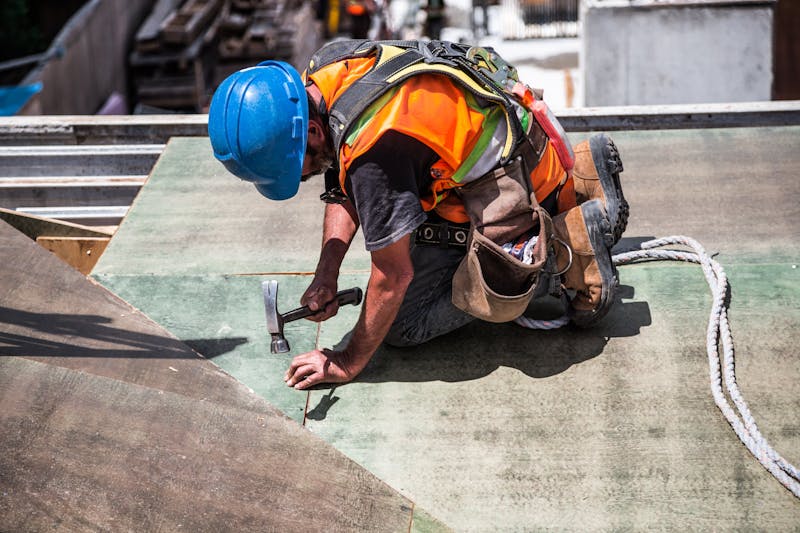
A small bump in an asphalt shingle can look harmless. Under that bump may be a roofing nail that was never seated correctly—or one that has moved enough to lift, rub, or puncture the shingle above it.
Roof nail pops deserve attention because the visible bump is only the symptom. The repair should address the fastener, the hole, the affected shingle, and any reason the problem may repeat.
What is a roof nail pop?
A nail pop is a roofing fastener that protrudes above its intended plane. It may be:
- Underdriven from the day of installation
- Driven at an angle rather than square to the deck
- Backed out after installation
- Placed outside the shingle manufacturer’s fastening zone
- Unable to hold because the roof deck is damaged or unsuitable
The raised nail may telegraph as a bump, lift the lower edge of the shingle course above it, or eventually break through the shingle surface. Nails visible on an exposed ridge-cap end or manufacturer-approved final detail are a separate condition; do not assume every visible fastener is a pop.
Why roof nails back out or sit high
The nail was underdriven
Pneumatic nailers must be adjusted for the deck, pressure, tool, and job conditions. Owens Corning says improper adjustment can underdrive or overdrive nails and contribute to raised tabs, buckling, sealing failures, corrosion, or blow-offs. See Owens Corning’s shingle-nailing guidance.
An underdriven head prevents the shingle above from lying flat. Repeated heating, cooling, and wind movement can make the distortion more noticeable.
The fastener was crooked or misplaced
A crooked nail does not clamp the shingle evenly. A nail outside the printed fastening zone may miss the intended layers or interfere with the course overlap. Every product has its own quantity, location, and high-wind instructions, so the wrapper or current manufacturer document—not a generic diagram—should govern.
The roof deck cannot hold it well
Soft rot, damaged panel edges, gaps, thin or unsuitable material, and repeatedly wet sheathing can reduce holding capacity. If several nails rise in one area, the contractor should consider the deck instead of treating every head as an isolated defect.
Deck movement can also reveal a broader moisture problem. Review the differences between materials in our plywood vs OSB roof decking guide and understand how opened-roof findings affect decking replacement scope.
The nail is too short or the wrong type
The 2024 International Residential Code lists permitted corrosion-resistant roofing nail materials and requires sufficient penetration into or through roof sheathing, but local adoption and amendments vary. Review the current IRC roof-assembly text, then confirm the adopted code and product instructions for the property.
Fasteners that do not meet the applicable product and assembly requirements should not be disguised with sealant.
How a raised nail creates leak risk
Asphalt shingles shed water through layering. A popped nail can disrupt that system in several ways:
- The head holds the covering shingle up and creates a path for wind-driven rain.
- The head rubs through the underside of the covering shingle.
- The nail punctures through the exposed face.
- A loose or removed nail leaves a hole in the shingle or underlayment.
- A raised tab does not seal correctly and becomes more vulnerable to wind.
Water may travel along the deck or a fastener before appearing indoors, so the ceiling stain may not sit directly below the pop. Our hidden roof leak detection guide explains why entry points and interior symptoms can be separated.
Signs you may be seeing nail pops
From the ground, a window, or a stable indoor attic location, look for:
- Small, distinct bumps in otherwise flat shingle courses
- A raised lower edge with no obvious debris underneath
- Rust staining or a round head breaking through the surface
- A repeating line of bumps that follows a course or deck seam
- Daylight, staining, or dampness near fastener penetrations in the attic
- Loose tabs or small wind-lifted areas near the bumps
Do not confuse nail pops with blisters, trapped debris, wrinkled underlayment, swollen sheathing edges, or impact marks. A roofer may need to lift the course carefully to confirm the cause.
What proper roof nail pop repair involves
The exact method depends on the product instructions and what the contractor finds. A durable repair generally follows this logic:
- Inspect the surrounding shingle and deck. The roofer checks for puncture, cracking, brittleness, moisture, and poor holding.
- Correct the fastener. A truly underdriven, correctly placed nail may be seated as the manufacturer permits. Crooked, overdriven, misplaced, corroded, or repeatedly loose nails may need removal.
- Secure the shingle correctly. Owens Corning advises that crooked or overdriven nails be removed, the hole filled with compatible asphalt roofing cement, and a new nail placed nearby; if that cannot be done, the shingle should be replaced. Product instructions control the actual repair.
- Address the hole and covering course. Any exposed opening, punctured face, or damaged seal must be restored with compatible materials.
- Correct the cause. Rotten decking, widespread nailing errors, or recurring movement requires a larger scope than spot treatment.
Simply smearing caulk over a bump can trap the defect in place, weather poorly, and leave the lifted course unresolved.
Why this is usually not a homeowner roof-access job
The material cost for one fastener is tiny; safe access and correct diagnosis are not. OSHA identifies roof edges, openings, loose material, weather, and changing surfaces as serious fall hazards in residential roofing. Read OSHA’s fall-protection overview.
Homeowners can document bumps with a zoom camera, check the attic during rain, and mark interior stains. Leave lifting shingles, removing nails, and working near roof edges to a qualified roofer with appropriate fall protection.
Roof nail pop repair cost drivers
There is no responsible national flat price for this repair. A contractor’s quote may be shaped by:
- Minimum service charge: Travel, setup, diagnosis, and warranty administration exist even for one defect.
- Roof height and pitch: Steep or multi-story access takes more safety equipment and time.
- Number and distribution: Five pops in one small area differ from repeated defects across several slopes.
- Shingle condition: Old, brittle, discontinued, or hard-to-match shingles increase the repair scope.
- Decking condition: Soft or damaged sheathing can turn a fastener repair into localized deck replacement.
- Nearby details: Valleys, walls, chimneys, vents, and flashing make access and water paths more complex.
- Leak investigation: Interior tracing, moisture readings, and attic access may be needed.
- Urgency and weather protection: After-hours or temporary dry-in work is a different service from a scheduled repair.
Ask for a written scope that states the number or area of repairs, whether shingles will be replaced, how holes will be treated, whether deck damage is excluded until opened, and what workmanship warranty applies. Use our broader roof repair cost guide to compare estimate assumptions.
When nail pops point to a larger problem
One isolated installation error may stay local. Request a broader inspection when you see a repeating grid or course, several leaks, soft decking, widespread lifted tabs, or recently installed shingles with numerous fastening defects.
For a newer roof, notify the installer in writing before another contractor alters the area. Photograph the condition and review both the contractor’s workmanship terms and the manufacturer’s material warranty. For older systems, compare repairability with the warning signs in when to replace a roof.
The bottom line
A roof nail pop is not repaired properly just because the bump disappears. The roofer should identify why the fastener is high, restore the shingle’s water-shedding layers, close any hole with compatible materials, and address weak decking or widespread nailing errors.
Document the condition from a safe location and request a written, product-aware repair scope. That gives you a better result than paying for a cosmetic dab of sealant that leaves the underlying failure in place.
Sources and image credit

Shingle Science Editorial Team
Independent trade-focused editorial team